
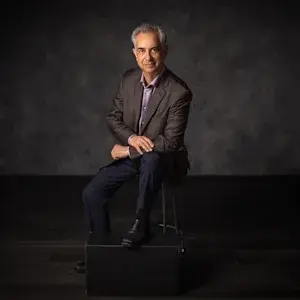
“Across five decades of broadband innovation, Yassini’s legacy stretches from trailblazing pioneer to Cable Hall of Fame inductee and Emmy Award winner —an enduring testament to his transformative impact on global connectivity.”

Rouzbeh Yassini-Fard is an Iranian-American inventor, technology entrepreneur, engineer, investor, author, and philanthropist whose pioneering work has redefined global connectivity. Widely celebrated as the “Father of the Cable Modem,” he invented the cable modem, founded LANcity, and played a pivotal role in establishing the DOCSIS standards through CableLabs, the Society of Cable Telecommunications Engineers (SCTE), and the International Telecommunication Union (ITU). Yassini is the author of ‘Planet Broadband’ (Cisco Press, 2003) and ‘The Accidental Network: How A Small Company Sparked A Global Broadband Transformation’ (West Virginia University Press, 2025).
Active in the industry for nearly five decades, Yassini’s invention and broader contributions to the cable and broadband industries have earned him some of the highest honors in the field, including the Technology & Engineering Emmy Award (2024), induction into the Cable Hall of Fame (2024), recognition as a Cable TV Pioneer (2012) and DOCSIS Pioneer (2019), and the prestigious Vanguard Award (2004), the National Cable and Telecommunications Association’s highest honor. Yassini currently serves as Executive Director of the University of New Hampshire Broadband Center of Excellence (UNHBCoE) and as founder and board member of the YAS Foundation. A frequent global speaker and industry contributor, he continues to champion the principle of “Broadband Equality,” advocating for universal broadband access worldwide.
Early life and career
Rouzbeh Yassini was born in Tehran, Iran, and attended Kharazmi High School. He studied at the University of Pahlavi for one year before immigrating to the United States in 1977. Settling in Morgantown, West Virginia, he enrolled at West Virginia University, where he earned a Bachelor of Science degree in Electrical Engineering in 1981. As a senior, he developed an interest in the emerging satellite communications industry and, with classmates, constructed one of the first 3.7–4.2 GHz down converters.
After graduating from West Virginia University in 1981, Yassini was recruited by General Electric (GE), where he began his career in the high-technology sector. In 1984, while at GE, he contributed to the development of the company’s first 5,000-gate custom-designed set-top chip for the cable television industry. Rising through the ranks to become Engineering Manager for Cable TV Systems and Microwave, he left GE in 1986 to join Proteon, a data networking company specializing in token ring networking products such as routers and bridges.
During his tenure at Proteon, Yassini conceived the idea of transmitting both video and data over the same cable — a concept that was widely considered unfeasible at the time. From 1988 and 1990, he served as president and CEO of Applitek (also spelled “Appletek” in some sources), a data networking firm, where he became convinced that combining video and data transmission is possible. In 1990, he acquired the company’s assets and Founded LANcity, where he developed the first cable modem and established the technological foundation for modern broadband communications.
LANcity
In 1990, Yassini founded LANcity, introducing the first high-speed communication modem designed to integrate with cable television networks. The company’s success created a new consumer electronics category—the cable modem—now used by millions of households worldwide. From the outset, Yassini emphasized open industry standards over proprietary protocols. With 13 employees, LANcity focused on building an “Ethernet bridge” to connect local networks to cable TV infrastructure. His vision and tremendous effort in Cable Technology and Data Networking eventually resulted in the invention of cable modem, creation of the broadband industry and the era of the high-speed internet.
Their first-generation modem, priced at $15,000, was not compatible with all cable configurations. Partnering with Digital Equipment Corporation (DEC), Yassini sought improvements, but when DEC faced financial distress, he recruited John Ulm from Hewlett-Packard to lead a redesign and brought on Kurt Baty to develop a 200,000-gate silicon chip.
By 1993, LANcity had released a $5,000 second-generation modem with significantly improved performance. In 1995, the company launched its third-generation “plug-and-play” model for under $500—affordable, reliable, and commanding approximately 80 percent of the global market share (Planet Broadband). Within five years, Yassini had reduced modem costs from $15,000 to under $500, making the technology widely accessible, a great achievement for LANcity. In mid-1996, Bay Networks acquired LANcity.
DOCSIS Standardization
In late 1996, following the sale of LANcity to Bay Networks, Yassini was invited to join Cable Television Laboratories (CableLabs) to spearhead the creation of the Data Over Cable Service Interface Specification (DOCSIS). Based in Denver, Colorado, he worked 18-hour days leading a team of volunteers drawn from more than 400 suppliers, 20 cable operators, and key contributors. His leadership brought together key stakeholders—cable companies, technology suppliers, and standards organizations—to replace fragmented proprietary systems with a unified, open standard.
Over six years, Yassini shaped DOCSIS from concept to deployment, balancing strategic vision, tactical execution, and financial planning. The result was a fully interoperable standard that empowered cable operators worldwide to deliver high-speed internet over their existing infrastructure. He also collaborated with the Society of Cable and Telecommunications Engineers (SCTE) and the International Telecommunication Union (ITU) to secure DOCSIS’s adoption as an international standard, ensuring global interoperability.
Yassini’s efforts addressed critical challenges such as bandwidth optimization and business quality service delivery. His pioneering role in cable broadband technology, coupled with his earlier achievements as founder and CEO of LANcity, earned him the title “Father of the Cable Modem” and the 75th Emmy Award for Technology and Engineering in 2024. Today, DOCSIS continues to serve as the foundation of high-speed cable internet, connecting hundreds of millions of users worldwide.
YAS Corporation (1997–2017)
Following his instrumental role at CableLabs, Yassini continued shaping the broadband industry through YAS Corporation, founded in 1997. As CEO and president of YAS (named after a pleasant-smelling Iranian flower of jasmine), he launched and advised numerous startups, guiding many toward successful acquisitions or public offerings. Alongside his leadership at YAS, he provided executive-level consulting for major industry players such as Comcast and served on advisory boards of numerous organizations.
Post-2003 Career & Leadership
Yassini Broadband Knowledge Center (2008)
In 2008, Yassini established the Yassini Broadband Knowledge Center in Boston—a think-tank facility dedicated to broadband research and technology demonstration. It hosted interactive exhibits, showcased broadband applications, and supported grant-funded innovation programs. The center was later transferred to the University of New Hampshire in 2012 through the Broadband Center of Excellence (UNHBCoE).
UNH Broadband Center of Excellence (2012–present)
As Executive Director of the Broadband Center of Excellence, Yassini has led interdisciplinary efforts to advance broadband research, expand access to underserved communities, and position UNH as a model “smart campus.” The center collaborates with policymakers, industry leaders, and researchers to promote broadband as a universal utility.
Philanthropy
Dr. Rouzbeh Yassini has long been committed to advancing education, innovation, and universal broadband access. In 2014, he donated his $10 million Broadband Center of Excellence (BCoE) to the University of New Hampshire, creating a hub for research, innovation, and practical applications in education, healthcare, public safety, and economic development.
YAS Foundation
Building on this vision, Dr. Yassini established the YAS Foundation in 2015 to promote innovation, accessibility, and cultural enrichment across technology, education, and the arts. The foundation supported a $1 million, seven-year grant to the BCoE, advancing research in universal and affordable broadband access worldwide. In 2017, together with Anousheh Ansari, he provided the $800,000 gift Stanford’s School of Humanities and Sciences to establish the Maryam Mirzakhani Graduate Fellowship in the Department of Mathematics. Following his mother death in 2022, he established the $2 million Nossrat Yassini Poetry Fund at UNH, honoring his mother and promoting poetry through festivals, workshops, and readings. The foundation also partners with universities to strengthen computing and engineering programs, including gifts to West Virginia University.
Board Memberships & Leadership Roles
Throughout his distinguished career, Yassini has held numerous leadership and advisory roles across a variety of organizations. He was the Founder, CEO, and President of LANcity until its acquisition by Bay Networks in 1996, and went on to establish YAS Corporation, leading it from 1997 to 2017. He served on the boards of BAS (acquired by ADC in 2000), TrueChat (acquired by Terayon in 2001), and Entropic (2001–2008, IPO 2007). His expertise was also sought by the UPC Technical Advisory Committee in the early 2000s and Liberty Global Inc., where he served from 2001 to 2017. Since 2012, he has been a driving force at the University of New Hampshire Broadband Center of Excellence (UNHBCoE), and from 2015 to 2020, he was a director at Visteon. In addition, Yassini is the Founder and a Board Member of the YAS Foundation (2015–present), and has contributed his leadership to Homeandthriving.
Education
- 2006 – Honorary PhD in Science and Technology from Merrimack College, N. Andover, MA
- 2003 – Honorary Ph.D. in Science from West Virginia University
- 1984–86 – M.B.A equivalent, GE, Financial Management Program (FMP)
- 1982–83 – O.D.U., Norfolk, VA, Nine-hour graduate study
- 1977–1981 – West Virginia University, B.S. Electrical Engineering
Awards & Recognitions
- 2024 – Received the 75th Technology & Engineering Emmy® Award from the National Academy of Television Arts and Sciences.
- 2024 – Inducted into the Syndeo Institute’s Cable Hall of Fame (Cable Industry Hall of Fame).
- 2019 – Inducted into the Light Reading Hall of Fame, Class of 2019.
- 2013 – Inducted into the West Virginia University Distinguished Alumni, Class of 2013.
- 2012 – Inducted into the Cable TV Pioneer Class of 2012 and received the Cablevision Executive Award.
- 2006 – Awarded an Honorary PhD in Science and Technology from Merrimack College, North Andover, MA.
- 2004 – Received the NCTA Vanguard Award, the cable industry’s highest honor, in recognition of contributions to establishing the first-ever industry standards.
- 2003 – Awarded an Honorary PhD in Science from West Virginia University.
- 2002 – Named to the CED Broadband Top 50 for leading three separate DOCSIS versions in under 40 months.
- 2000 – Inducted into the WVU Lane Department of Academy as its youngest member.
- 1997–1999 – Named CED Magazine’s “1998 Man of the Year” and recognized as the “Father of the Cable Modem” for creating and fostering the cable modem “Broadband”. Innovated first ever industry standards process leading to creation of global DOCSIS standards & certifications through the Cable Television Laboratories and SCTE, later adopted by the ITU in 2000. foundational to the multibillion-dollar Broadband industry revolution.
Achievements
- 2013 – Established the ‘Broadband Center of Excellence’ at the University of New Hampshire to advance the vision of ubiquitous broadband.
- 2011 – ‘Endeca’ (1997 investment) acquired by Oracle.
- 2010 – ‘BroadSoft’ (2000 investment), a leader in VoIP, completed its IPO.
- 2009 – ‘WildBlue’ (1999 investment), a satellite internet provider, acquired by Viasat.
- 2008 – Founded the ‘Yassini Broadband Knowledge Center’, a hub for broadband research and innovation.
- 2007 – ‘Entropic Communications’ (2001 investment), a home networking silicon vendor, completed its IPO.
- 2003 – Chaired the cable industry’s first ‘Vendor & Operator Executive Advisory Forum’.
- 2001 – Directed the global development and deployment of DOCSIS 2.0, enabling symmetrical broadband services.
- 2000 – Introduced ‘DOCSIS 1.1’ standards to the cable industry.
- 1999 – Principal contributor to the retail launch of ‘DOCSIS 1.0’ cable modems—the industry’s first standardized certification process for consumer broadband equipment.
- 1996–2017 – Founder & CEO, ‘YAS Capital Partners LLC’, which launched 9+ startups (valued from \$10M to \$2.3B through acquisitions or IPOs). Provided CEO-level consulting to service providers.
- 1990–1996 – Founder, CEO & President, ‘LANcity Corporation’. Pioneered the broadband industry by inventing the first commercial cable modem. Company acquired by Nortel (Bay Networks) in 1996.
- 1988–1989 – Successfully turned around a struggling \$30M investment in ‘Applitek’, leading to its acquisition by LANcity.
- 1986–1988 – Director of Engineering, ‘Proteon Inc.’ Developed the first intelligent network hub.
- 1981–1986 – At ‘General Electric (ITT)’, co-developed the first digital TV platform and contributed to the first bandwidth-compression set-top box. Member of GE’s ‘Financial Management Program’.
Publications
- The Accidental Network: How a Small Company Sparked a Global Broadband Transformation – WVU Press, 2025, ISBN 978‑1959000600; authored by Rouzbeh Yassini‑Fard, with Stewart Schley (author) and a foreword by John Chambers.
- Planet Broadband – Cisco Press, 2004, ISBN 978‑1587200908; co-authored with Stewart Schley, Leslie Ellis, and Roger Brown.
- Internet of People: The Future of Broadband – Broadband Library, Winter 2014.
- Television White Spaces: Assessing TVWS for Rural Broadband Access – UNHBCoE, November 2014.
- Broadband 2030: The Networked Future – Broadband Intelligent Series, UNHBCoE, December 2013.
- Broadband 2020: Achieving Ubiquity – Broadband Intelligent Series, UNHBCoE, November 2013.
- Broadband Intelligent Series – a collection of white papers on digital services including voice, data, and video.
- Numerous industry articles, thought leadership pieces, and interviews on the future of broadband published in technology magazines, journals, and conference proceedings worldwide.
References
6. Russell McGuire. “Book Brief: The Accidental Network.” Clearpurpose, September 1, 2025.
7. Rouzbeh Yassini. “Broadband 2020: Achieving Ubiquity.” UNHBCoE, November 2013.
8. Rouzbeh Yassini. “Broadband 2030: The Networked Future.” UNHBCoE, December 2013.
15. Planet Broadband. “LANcity Awarded Technology and Engineering Emmy.” 2024.
19. Cable Television Pioneers. “Cable Television Pioneers Class of 2012.” Cable TV Pioneers, 2012.
26. Roger Brown. “Rouzbeh Yassini Fulfills a Tall Order.” CED Magazine, December 31, 1998.